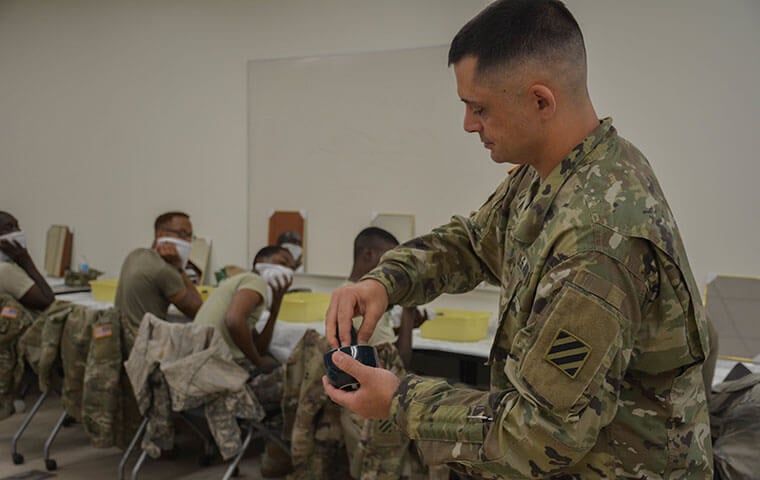
 Sgt. 1st Class Bartholomew Anderson, the 3rd Infantry Division Sustainment Brigade's noncommissioned officer in charge of medical operations, gives tips and techniques for wet shaving during a clinic May 22 at the brigade's organizational classroom. Using things such as a hot towel, a shave brush with soap, and a single-blade razor, it is easier to prevent pseudofolliculitis barbae, or otherwise known as razor bumps. (Army photo by Sgt. Caitlyn Smoyer)
By: FEDweek Staff
Sgt. 1st Class Bartholomew Anderson, the 3rd Infantry Division Sustainment Brigade's noncommissioned officer in charge of medical operations, gives tips and techniques for wet shaving during a clinic May 22 at the brigade's organizational classroom. Using things such as a hot towel, a shave brush with soap, and a single-blade razor, it is easier to prevent pseudofolliculitis barbae, or otherwise known as razor bumps. (Army photo by Sgt. Caitlyn Smoyer)
By: FEDweek StaffThe Air Force has made changes in its guidelines for personal appearances, to include new standards airmen must adhere to while in uniform.
They include:
· A requirement that all officers maintain one complete Operational Camouflage Pattern (OCP) uniform set.
· A ban on the wearing of eyelash extensions unless there is a clear medical reason – supported by documentation – to do so. Airmen have 30 days to comply with this new regulation.
· A minimum height for combat boots. They must be between eight and 12 inches in height from the bottom of the heel tread to the top of the boot’s back. Soling material cannot exceed two inches in height. Short boots are no longer allowed. Airmen have 90 days to comply with this change.
· Clear guidelines for folding or cuffing OCP sleeves. Cuffs can remain visible when sleeves are not rolled up. Airmen also can fold their sleeves once or twice. Visual documentation that shows what is allowed is available.
The Space Force plans to release similar guidelines in the near future.
Meanwhile, the Army has updated its facial hair policy.
Soldiers must be clean-shaven at all times unless they are granted certain temporary or permanent exceptions, under a new policy that addresses regulations on permissible facial hair. The rule applies to all situations, including time in civilian clothes as well as in uniform.
Exemptions for non-religious reasons have to be accompanied by medical-profile documentation that iterates the need for accommodating potential health conditions, to include pseudo-folliculitis barbae (razor bumps) – a common condition experienced primarily by African-American and Black men. Such waivers must be granted by a lieutenant colonel (O-5) in the chain of command.
In its official directive, the Army outlined scenarios in which temporary waivers could be granted for four, eight or more weeks – depending upon the severity of the skin conditions caused by frequent shaving.
Permanent exceptions can be granted for religious reasons.
Soldiers who seek either temporary or permanent waivers are required to keep copies of necessary documents.
“This update reinforces our culture that fosters discipline – and discipline equals readiness,” said Sgt. Maj. of the Army Michael R. Weimer. “Through phased implementation we are working with providers through commanders to effectively address grooming standards to ensure we maintain a professional force.”
Soldiers are being told to expect help complying with the change from their commanders, leaders and health-care professionals, who would provide monitoring and treatment plans for them. Those who cannot meet the new standards “within a reasonable time” can expect to be kicked out of the Army.
Judge Issues Enforcement Order to Restore Union Rights at VA, Threatens Contempt
Pentagon Orders “Hard Reset” of Legal Operations Within Six Months
Hegseth: Supervisors Expected to Encourage Personnel to Volunteer for ICE, CBP Details
VA Ends Reporting of Some Veterans to Federal Gun Background Check System