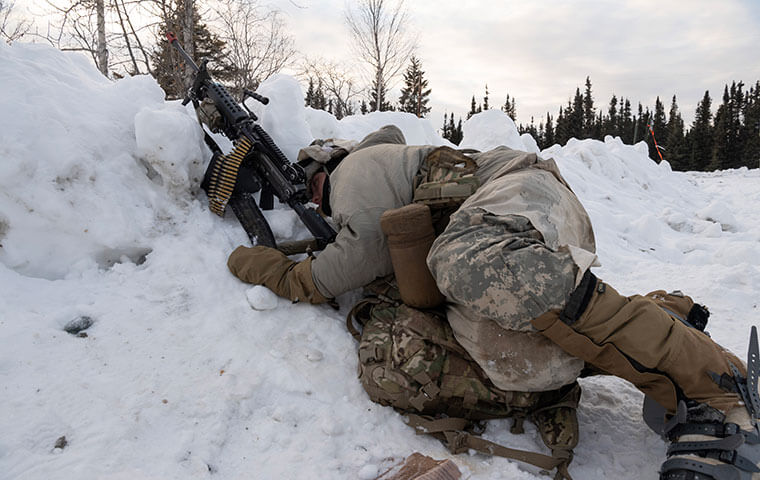
 A U.S. Army infantryman with Bayonet Company, 1st Battalion, 5th Infantry Regiment, 1st Infantry Brigade Combat Team, 11th Airborne Division, takes cover during a simulated indirect fire attack while acting as opposition forces for Joint Pacific Multinational Readiness Center-Alaska 23-02 at Yukon Training Area, Alaska, April 1, 2023. JPMRC-AK 23-02 is a display of the 11th Airborne Division’s ability to survive and thrive in the Arctic, and its soldiers’ ability to fight and win our nation’s wars anywhere. (Air Force photo by Alejandro Peña) The appearance of U.S. Department of Defense (DoD) visual information does not imply or constitute DoD endorsement.
By: FEDweek Staff
A U.S. Army infantryman with Bayonet Company, 1st Battalion, 5th Infantry Regiment, 1st Infantry Brigade Combat Team, 11th Airborne Division, takes cover during a simulated indirect fire attack while acting as opposition forces for Joint Pacific Multinational Readiness Center-Alaska 23-02 at Yukon Training Area, Alaska, April 1, 2023. JPMRC-AK 23-02 is a display of the 11th Airborne Division’s ability to survive and thrive in the Arctic, and its soldiers’ ability to fight and win our nation’s wars anywhere. (Air Force photo by Alejandro Peña) The appearance of U.S. Department of Defense (DoD) visual information does not imply or constitute DoD endorsement.
By: FEDweek StaffArmy researchers are studying ways to ensure that soldiers can use their hands effectively while they operate in extremely cold conditions.
“Impaired manual dexterity and hand function in the cold has severe adverse effects on the ability to perform important military tasks such as digital command-and-control functions weapons use and delivery of medica treatment,” said Afton Seeley, holder of a doctorate in research physiology and principal investigator with the U.S. Army Research Institute of Environmental Medicine’s principal investigator.
While gloves help, Seeley noted, they also hinder manual dexterity and precision. He added that some methods of keeping hands warm require power components that could become problematic while in the field.
One possible solution, Seeley believes, is the use of vascular conditioning – a procedure that employs a blood pressure cuff which would reduce blood flow for five minutes at a time Altering blood flow, researchers hope, could condition hands into favorably reducing their usual response to extreme cold.
“We hypothesized that five days of vascular conditioning would improve blood flow and skin temperatures in response to cold air and cold-water immersion and subsequently led to improvements in manual dexterity tasks such as magazine loading and hand/finger pinch strengths,” Seeley said.
These pressure-based cuffs could be incorporated in a uniform sleeve, he added.
“It may prove to be an inexpensive and logistically superior countermeasure to employ prior to cold exposure,” Seeley said. “Ultimately, if vascular conditioning provides significant improvement in manual dexterity and cold tolerance, it will be transitioned to use with field medics in units such as the 11th Airborne in Alaska.”
Judge Issues Enforcement Order to Restore Union Rights at VA, Threatens Contempt
Pentagon Orders “Hard Reset” of Legal Operations Within Six Months
Hegseth: Supervisors Expected to Encourage Personnel to Volunteer for ICE, CBP Details
VA Ends Reporting of Some Veterans to Federal Gun Background Check System