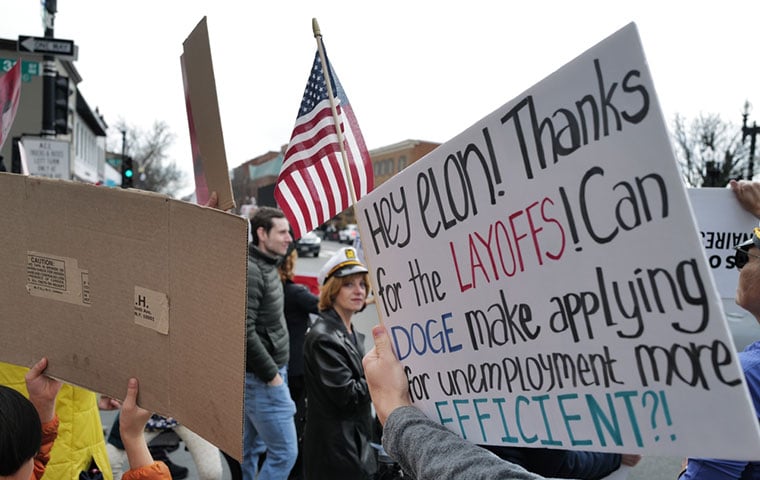
 Washington DC - March 2025: Protest on government layoffs at the National Mall. Image: Phil Pasquini / Shutterstock.com
By: FEDweek Staff
Washington DC - March 2025: Protest on government layoffs at the National Mall. Image: Phil Pasquini / Shutterstock.com
By: FEDweek StaffBoth those who voted in the 2024 elections and those who didn’t “are not sold on cuts to government funding and personnel” even though they have an overall negative view toward the government, a Partnership for Public Service poll has found.
A posting breaking out survey data in that way shows that those who didn’t vote—who tend to not follow news about politics and government as closely as those who did—overall view the government in a more negative light but also are more likely to be neutral or to say they cannot make a judgment on specific issues.
“Across a wide variety of government-related questions, nonvoters consistently answered “don’t know” or “not sure” at much higher rates than voters . . . The specific reasons for this difference are unclear, although the uncertainty may stem from some factors that keep people from voting: political fatigue, apathy towards government or a feeling that government has little impact on their daily life,” it said.
For example, while responses were about evenly split among voters regarding the government’s impact—47 percent deeming it positive and 46 percent negative, with the rest “don’t know”—the figures for nonvoters were 25, 40 and 35. Similarly, while 64 percent of voters said they have favorable views of civil servants with 18 percent unfavorable with the rest saying they “can’t rate,” the figures among nonvoters were 31, 19 and 50.
Among voters, 44 percent said they support and 52 percent said they oppose “the changes to the federal government made by the Trump administration”; 35 percent said that “layoffs and cuts to the federal government” will make their life better, compared to 48 percent who said those actions will make their life worse. Among non-voters, the figures were 28 and 40, and 17 and 38.
“This suggests that nonvoters may hold complex views about government, being more discontent with the way it works than voters but also disapproving of a ‘slash and burn’ approach to reform,” the Partnership said.
Nearly 10,000 Federal Offices Don’t Meet Usage Standards
OPM Plan on Employee Ratings Asking for Abuse, Says Senior House Democrat
OK, FERS and TSP, but What About Social Security Retirement Income?
Conversions to Schedule P/C Pending; Acknowledgement Form Draws Attention
Senate Passes DHS Funding Deal, but Stalls in House; Trump Signs Order to Pay TSA Personnel
See also,
Calculating Service Credit for Sick Leave At Retirement
FERS Supplement vs The 10% Pension Bonus
How Your FERS, Social Security and TSP Payments Get Taxed