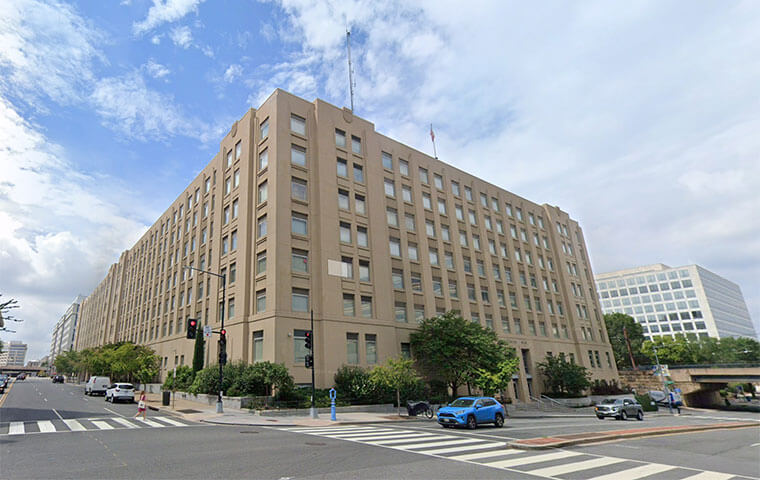
 GSA Regional Office Building (ROB), located at 301 7th St SW, Washington, D.C. GSA listed the property for accelerated disposition last year. Image: Google Maps screengrab
By: FEDweek Staff
GSA Regional Office Building (ROB), located at 301 7th St SW, Washington, D.C. GSA listed the property for accelerated disposition last year. Image: Google Maps screengrab
By: FEDweek StaffThe GAO has laid out a series of long-familiar issues related to federal buildings before a House hearing examining a maintenance and repair fund under the GSA, stressing that for more than a decade, Congress has allowed GSA to spend less from that fund than it takes in as rent from tenant agencies.
The result, a witness said, is a maintenance and repair backlog estimated late last year at $25 billion—a separate recent report suggested that the cost could be twice that much—and spiraling costs because “deferring maintenance can worsen the condition of agencies’ assets and lead to premature replacement, which can be significantly more costly than the repairs, had they not been delayed.”
“For example, according to GSA, 13 out of 17 major repair and alteration projects for GSA buildings included in GSA’s fiscal year 2024 congressional budget justification were submitted in prior years.14 Collectively, GSA estimated that those 13 projects combined would cost $300 million more in fiscal year 2024 than in the years in which they were originally submitted,” he said.
Deferred maintenance also has been cited as a factor in numerous report of health, safety, fire and other hazards in federal buildings.
The testimony also addressed the long-standing issue of difficulty in disposing of underused or unused office space, saying that agencies “have struggled to determine how much space they need to fulfill their missions and identify the funding to consolidate operations, reconfigure spaces, and prepare unneeded property for disposal,” he said. Meanwhile, “Uncertain upfront funding can hinder agencies’ willingness and ability to pursue space reduction efforts . . . costing the federal government hundreds of millions of dollars in additional lease payments.”
He added that the first reports from agencies are due soon under an early-2025 law requiring disclosure of facilities that don’t meet certain usage requirements, which if unaddressed over two years would trigger a shortcut process for shedding them.
Federal office building sold, 940,000 sq ft
Meanwhile, the GSA has announced the first sale of a major federal property under its program begun last year listing more than three dozen buildings for “accelerated disposition.” The building has nearly 1 million square feet and is on a lot of more than three acres in a redeveloping area of Southwest D.C. in the Waterfront neighborhood, near L’Enfant Metro station.
The building, dating to the 1930s when it began as a warehouse, was later turned into a regional headquarters for the GSA and afterward housed part of DHS but has been vacant since this time last year. “The sale is expected to save taxpayers over $200 million in delinquent maintenance and $5.5 million in annual operating and maintenance costs,” it said.
The GSA estimates that sale of all the properties on that list—several others are in the national capital area but most are scattered nationwide—would eliminate $5 billion in delinquent maintenance and annual operating costs. They range from several thousand rentable square feet to more than two million, in the case of an Agriculture Department headquarters building.
Conversions to Schedule P/C Pending; Acknowledgement Form Draws Attention
Federal Employee Survey Shows Plummeting Views on Engagement, Leadership, Performance
OPM Takeovers of RIF, Suitability Appeals Diminish Legal Rights, Unions Say
Judge Orders VA to Reinstate Union Contract for 320,000 Workers
Retirement Application Processing Backlog Nearly Doubles in Four Months
See also,
Calculating Service Credit for Sick Leave At Retirement
FERS Supplement vs The 10% Pension Bonus
How Your FERS, Social Security and TSP Payments Get Taxed
Where Should I Put My TSP in Retirement