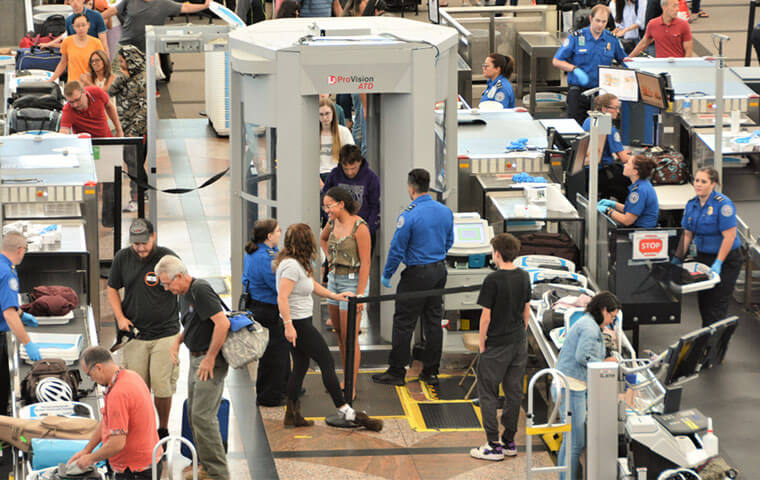
 A judge earlier has ordered DHS to notify screeners that the collective bargaining agreement with the AFGE union “remains applicable and binding." Image: Jim Lambert/Shutterstock.com
By: FEDweek Staff
A judge earlier has ordered DHS to notify screeners that the collective bargaining agreement with the AFGE union “remains applicable and binding." Image: Jim Lambert/Shutterstock.com
By: FEDweek StaffA federal judge has ruled that the most recent move by the DHS to end union representation rights for some 47,000 security screeners of its component TSA violated an injunction that had been issued against an earlier similar move.
At issue before District Judge Jamal N. Whitehead of the U.S. District Court for the Western District of Washington was a “policy determination” that was to have taken effect January 18, citing a pair of executive orders from President Trump to end union representation rights for the majority of federal employees on security and related grounds. The DHS said the effect would be to end all bargaining and grievance procedures between the TSA and the AFGE union.
The judge ruled, though, that that action was subject to an injunction issued against a similar determination that DHS had issued before the executive orders. In that case, a different judge had ruled that the AFGE was likely to prevail in its arguments that the department’s action violated the Administrative Procedure Act and due process requirements.
He ordered DHS to notify screeners that the second action will not take effect and that the collective bargaining agreement with the AFGE union “remains applicable and binding, and the currently pending grievances and arbitrations submitted under the 2024 CBA will continue to be processed.”
“The administration’s repeated efforts to strip these workers of a voice in their working conditions should concern every person who steps foot in an airport,” the AFGE said.
Meanwhile U.S. Court of Appeals for the Ninth Circuit has heard arguments in a broader case against the executive orders brought by the AFGE and other unions. A panel of that court last August had lifted an injunction that a lower judge had issued, in a ruling that focused on legal standards for issuing injunctions.
The latest hearing involved the merits of the unions’ arguments that the orders were in fact political retaliation against them in violation of the First Amendment.
A separate similar case brought by the NTEU union—in which a different appeals court also lifted a lower judge’s injunction—also remains pending, with a general expectation that one or the other or both ultimately will end up before the U.S. Supreme Court.
Conversions to Schedule P/C Pending; Acknowledgement Form Draws Attention
Federal Employee Survey Shows Plummeting Views on Engagement, Leadership, Performance
OPM Takeovers of RIF, Suitability Appeals Diminish Legal Rights, Unions Say
Judge Orders VA to Reinstate Union Contract for 320,000 Workers
Retirement Application Processing Backlog Nearly Doubles in Four Months
See also,
Calculating Service Credit for Sick Leave At Retirement
FERS Supplement vs The 10% Pension Bonus
How Your FERS, Social Security and TSP Payments Get Taxed
Where Should I Put My TSP in Retirement