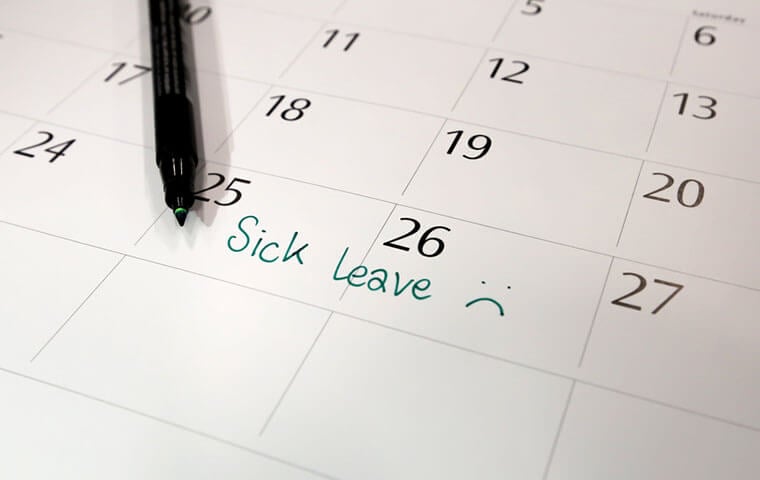
 Unlike annual leave, sick leave has no cash value. Image: Kerlon/Shutterstock.com
By: Reg Jones
Unlike annual leave, sick leave has no cash value. Image: Kerlon/Shutterstock.com
By: Reg JonesLast week I went over the rules governing the earning, accumulation and use of sick leave. This time I want to fill you in on four other sick leave related topics: advanced sick leave, recrediting sick leave on a break in service, and what happens to sick leave at retirement.
Advanced Sick Leave
If you have a medical emergency or are engaged in the adoption of a child and do not have sufficient sick leave to cover the situation, your agency – in its discretion – may advance you a maximum of 30 days of sick leave. It may also advance you a maximum of five days of sick leave for family care or bereavement purposes. Just be aware. Such leave must be earned back by the time you leave government service or it becomes a debt you’ll have to pay.
Recrediting Sick Leave
If you leave the government and later return to work for it, any unused sick leave you had when you left will be recredited to you as long as it wasn’t either forfeited before Dec. 2, 1994 or used in the computation of a retirement annuity.
Sick Leave and Retirement
When you retire, any unused sick leave will be used in the computation of your annuity. However, the rules are different for those covered by CSRS and FERS.
If you are covered by CSRS, you’ll get full credit for your sick leave balance.
That is also true of those retiring under FERS in calendar year 2014 or later. However, the rules prior to that were different. Only 50 percent of sick leave was credited for those who retired from October 28, 2009, through December 31, 2013; for those who retired before the former date, it generally was not creditable at all, with few exceptions.
When you retire, unused sick leave will be converted into months for your annuity calculation. By law, 2,087 hours equals one year of service. For retirement purposes, all days are 5.797+ hours long. You get that figure by dividing 2,087 by 360 (the product of 12 30-day months). So, approximately 174 hours (5.797+ x 30) of unused sick leave equals a month of creditable time in the calculation.
If you are a CSRS retiree, each year of sick leave credit will increase your annuity by 2 percent, each month after that by 1/6 of 1 percent.
If you are a FERS retiree retiring under age 62 and/or with less than 20 years of service, a year of sick leave credit would increase your annuity by 1 percent, each month after that by .0833 percent. If you retired at age 62 or later with at least 20 years of service, the annual multiplier would be increased from 1 percent to 1.1 percent (and the monthly multiplier also by a tenth).
If you have days of actual service that don’t add up to a full month, those days will be converted in the same way and added to your unused sick leave credit beyond the last full month, possibly yielding another full month. Any days beyond the last full month are dropped.
Note: If you are a FERS employee who will have a CSRS component in your annuity, any sick leave hours up to the maximum number you had when you transferred to FERS will be credited to your CSRS annuity. Any sick leave hours above that number will be credited to your FERS annuity.
A closing word
Unlike annual leave, sick leave has no cash value. In other words, you can’t receive a lump-sum payment for it on separation as you will with unused annual leave.
Former head of retirement and insurance policy at the Office of Personnel Management, and longtime FEDweek contributor, Reg Jones is known throughout the federal workforce community as an authority on pay and benefits.
Nearly 10,000 Federal Offices Don’t Meet Usage Standards
Conversions to Schedule P/C Pending; Acknowledgement Form Draws Attention
OPM Plan on Employee Ratings Asking for Abuse, Says Senior House Democrat
OK, FERS and TSP, but What About Social Security Retirement Income?
See also,
Calculating Service Credit for Sick Leave At Retirement
FERS Supplement vs The 10% Pension Bonus
How Your FERS, Social Security and TSP Payments Get Taxed